How it works
Notice. Validate. Develop. Deliver.
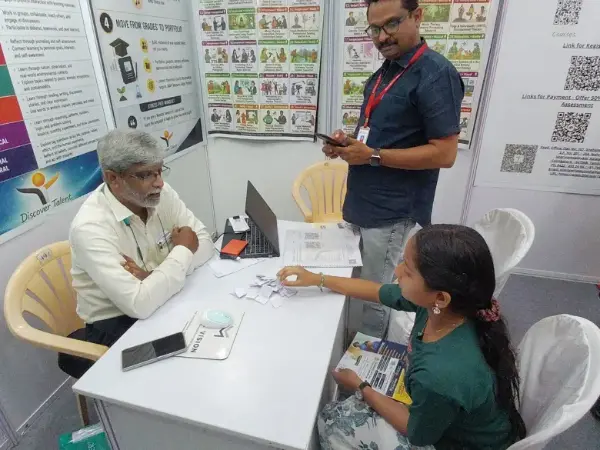
A talent someone notices needs to be confirmed before you act on it. We confirm it by cross-checking four sources.
- 1
Notice
The 2-minute Discovery shows where your hours naturally go, and what others ask you to help with.
- 2
Validate
In the session we compare four sources. When they agree, the talent is validated.
- 3
Develop
A plan: which subjects, courses and kinds of work fit.
- 4
Deliver
Follow-up while you act on the plan.
The four sources we cross-check
1. What others noticed
Parents, teachers, friends: what do they ask you to help with?
2. Your own answers
What you enjoy, and what you feel good at, from the Discovery and the conversation.
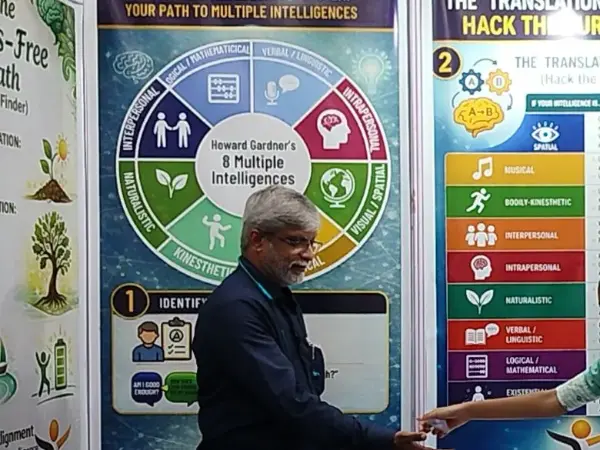
3. Multiple Intelligences profile
A shared language for naming strengths, based on Howard Gardner's eight intelligences.
4. Real evidence
Marks, activities, achievements and teachers' remarks.
Multiple Intelligences, in plain words
Howard Gardner described eight ways people are intelligent: linguistic, logical-mathematical, spatial, musical, bodily-kinaesthetic, interpersonal, intrapersonal and naturalist. Most people are strong in two or three. Schools mostly measure the first two.
Why talent first
No field has vanished
Every field still needs people. Scope and opportunities exist everywhere.
Unaware is not "no scope"
Not knowing about a field doesn't mean it lacks scope. But choosing a field where you're not naturally strong is the wrong path for wellbeing.
The talent revolution
Today's education still follows the industrial model. Since 2020, the world rewards people who build on their talents.
Talent vs skill
Talent is the foundation. Skill is an add-on, and on its own it is short-lived.
What the assessment is, and is not
It is guidance that helps you choose with more than marks. It is not a prediction or a guarantee, and no single test proves a talent. That is why we cross-check four sources.
Start with the 2-minute Discovery
See where your hours naturally go, then talk it over in a free session.